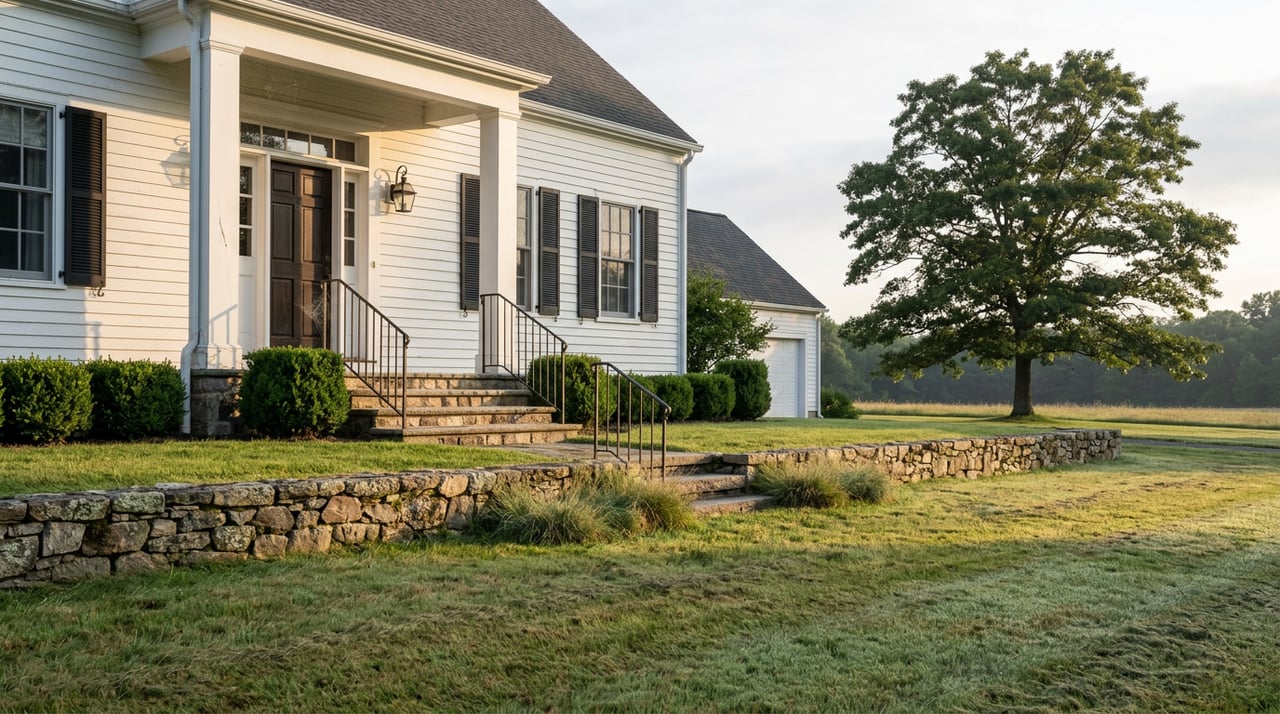
You are under contract on a farmhouse on Clintonville Road. The current tax bill looks reasonable, lower than you expected for four acres with a barn and a hayfield. Your agent mentions, almost in passing, that the land carries a farm classification under Connecticut's Public Act 490. You nod. It sounds like a nice bonus that came with the property. Then the closing happens, the deed records, and the following July your assessment jumps because that lower bill was never yours to keep. It belonged to the seller.
That surprise is the whole story in North Branford this fall, and it is worth understanding before you sign anything, whether you are buying a working farm parcel or selling one.
The Tax Break Is Personal, Not Permanent
Public Act 490, passed by the Connecticut legislature in 1963, lets towns assess farm, forest, and open space land at its current use value instead of its fair market value. For a hayfield or an orchard, that difference can be substantial, since the land is valued as farmland rather than as a buildable residential lot. It is one of the reasons North Branford still looks the way it does, with working fields tucked between subdivisions along Clintonville Road and Middletown Avenue.
Here is the part that catches people off guard at the closing table: state law is explicit that the classification is personal to the owner who applied for it and does not run with the land itself. When a PA 490 parcel sells or transfers, the classification ends as of that date. The buyer does not inherit the tax break. The buyer has to apply for it fresh, and the town assessor decides all over again whether the land still qualifies.
If you are buying, that means your first tax bill after closing may reflect full fair market value assessment, not the use value number you saw on the seller's disclosure, until you file your own application and the town approves it.
The Ten-Year Clock Nobody Mentions
The law also builds in a penalty designed to stop landowners from using PA 490 purely to hold land cheaply while waiting for a buyer who wants to develop it. If land is pulled out of classification, whether through a sale, a transfer, or a change in use, within the first ten years of that particular owner's enrollment, a conveyance tax applies on top of the regular closing costs. The rate starts high and steps down every year:
| Year of Classification | Conveyance Tax Rate |
|---|---|
| Year 1 | 10% |
| Year 2 | 9% |
| Year 3 | 8% |
| Year 4 | 7% |
| Year 5 | 6% |
| Year 6 | 5% |
| Year 7 | 4% |
| Year 8 | 3% |
| Year 9 | 2% |
| Year 10 | 1% |
| Year 11 and beyond | No penalty |
That tax is calculated on the sale price and gets recorded as a lien on the land records at the town clerk's office when the deed is filed or the use changes. It is not a rumor or a scare tactic. It is written into the Connecticut General Statutes, and the Department of Agriculture confirms it plainly in its own PA 490 guidance for landowners.
The clock starts on the date the current owner's classification began, not the date the land was first farmed. That means two neighboring parcels with identical hayfields can be sitting at completely different points in that ten-year window, and there is no way to know which one without asking the assessor directly.
Why This Matters More in North Branford Right Now
North Branford is still a working farm town in a way that shows up on the ground, not just in old zoning maps. Rose Orchards on Branford Road runs pick your own apples, peaches, and berries from spring through fall and bakes its own cider donuts on site. In Northford, Cecarelli's Harrison Hill Farm has grown vegetables on the same ground since 1912, now in its third generation under the DellaCamera family, selling sweet corn, tomatoes, and peppers straight from the farm stand. This is not decorative farmland. It is active production, and a meaningful share of it is likely enrolled under PA 490 given how the assessment math works for anyone still farming at scale.
What changed recently is the pressure on that land. On January 22, 2026, North Branford's Planning and Zoning Commission voted 5 to 0 to rezone two parcels at 435 and 465 Foxon Road from R-40 residential to B-1 business. Commission members were direct about what the vote signals: it sets the tone for development in the west end of Route 80, the state highway that runs through the heart of town and already carries roughly 12,700 vehicles a day past nearby commercial sites. A residential-to-business rezoning on a state highway corridor is exactly the kind of shift that makes adjacent land more valuable for something other than farming, and more valuable land is precisely what tempts an owner to sell or convert use during a still-active PA 490 window.
If you are buying near that corridor, or anywhere in town where farmland borders a road with commercial potential, the conveyance tax exposure is not theoretical. It is the mechanism that decides whether a seller's asking price actually nets what they expect, and whether a buyer's total closing cost is higher than the purchase and sale agreement implies.
What to Ask Before You Sign
A handful of direct questions to the seller and the town assessor's office can settle all of this before it becomes a surprise:
- Is the property currently classified under PA 490 as farm, forest, or open space land, and for how long has the current owner held that classification?
- Is the ten-year recapture window still open, and if so, who is contractually responsible for the conveyance tax at closing?
- Will the buyer need to file a new application to keep any use-value assessment, and does the current use still meet the town's farming or acreage standards?
- Has the town recorded any existing lien tied to a prior transfer of this parcel?
North Branford's assessor accepts new PA 490 applications between September 1 and October 31 each year, with an extended window through December 30 during a town-wide revaluation year. As of today, that fall filing period is open right now, which means anyone closing on farmland or forest acreage between now and Halloween is inside the one window of the year that actually matters for keeping a use-value assessment intact.
A Few Questions Worth Asking
Does every farm sale in North Branford trigger this tax? No. If the land has been classified for more than ten years under the current owner, or if the buyer keeps the property in qualifying farm use and successfully reapplies, there may be no recapture tax due at all. The penalty only applies within that ten-year window when the use actually changes or the classification lapses.
What if only part of the property is actively farmed? The assessor looks at the whole parcel, factoring in acreage, actual farming use, productivity, and income generated, so a property with a house, a barn, and a working field is evaluated differently than one where farming has clearly stopped. This is a case where a conversation with the assessor before you make an offer saves guesswork later.
Can the new owner just reapply and pick up where the seller left off? The application itself is straightforward, but approval is not automatic. The assessor reviews the property under the same statutory criteria as any new applicant, and there is no minimum acreage requirement written into state law, though some towns set their own thresholds for open space classification specifically.
North Branford's fields are part of what makes the town worth choosing, but the tax mechanics underneath them are not something a standard home inspection catches. If you are weighing a purchase near working farmland, or you are the one selling a parcel that has carried a PA 490 classification for years, a conversation before the purchase and sale agreement is signed costs nothing and can prevent a genuinely expensive surprise after the deed records.
If you are thinking about buying or selling in North Branford this fall, Jules G. Etes can help you sort through the assessor's records, the filing deadlines, and the actual math before you're locked into a contract. Request a free home valuation and start the conversation with someone who already knows which questions the town will ask.